
Compare broad manual grinding with iMech Pro local opening for a published flip-chip micro-short case. Targeted access and MIP residue removal can help retain electrical connections for post-decapsulation retesting.
Source & case Plasma benefits Evidence images Local opening & testing FAQ
01 · PUBLISHED CASE
Preserve the evidence before approaching the defect
Case source: UR Hongxin Testing (Foxconn–UR), “IC Chip Micro-short Failure Analysis”. Published on its WeChat account on 17 April 2026, with a corresponding website article dated 18 April. Read the publisher’s article ↗
This page summarizes the published case and adds ICDECAP preparation guidance. The publication refers to plasma decapsulation; ICDECAP confirms that its iPlasma system was used. The local-opening workflow with iMech Pro and MIP below is ICDECAP’s proposed improvement.
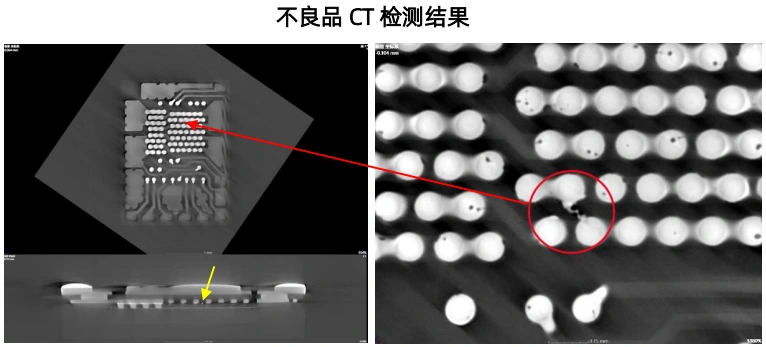
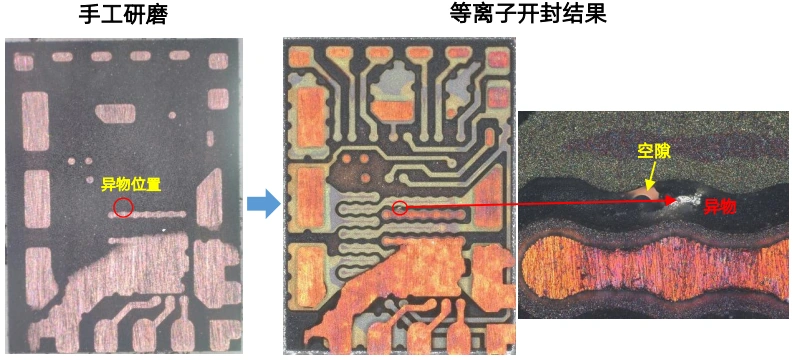
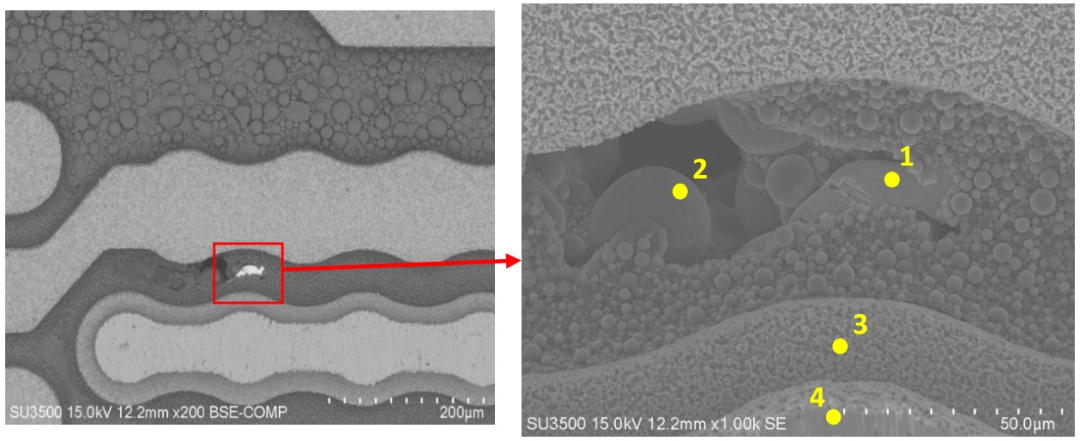
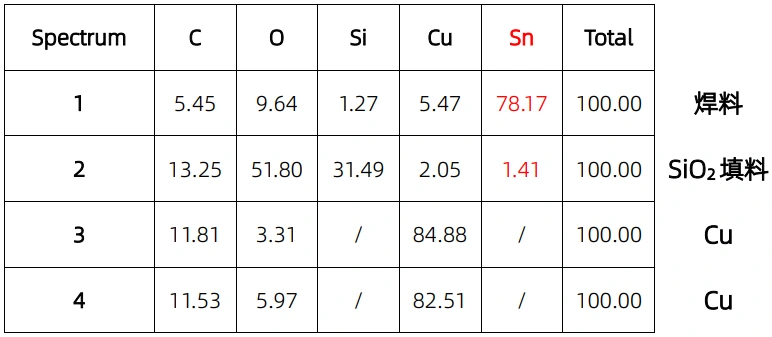
The publisher describes an ICT micro-short that could disappear with electrical testing. X-ray and LIT did not localize the defect; CT revealed a nearly broken filament. Manual grinding, plasma opening and SEM-EDS associated the filament with solder. The authors attributed the failure to solder overflow during flip-chip assembly and reported a nearby unfilled region.
Expose the failure for analysis—not merely until the short disappears.
Electrical excitation, material removal and cleaning can alter a fragile conductive connection. Link low-disturbance localization, images of the same region and composition analysis while approaching the target in stages.
02 · PLASMA VALUE
Less preparation interference. Better access to the target.
Flip-chip interconnects sit between the die and substrate, often next to underfill, filler particles and metallization. Access requires removal of covering material while retaining as much of the connection geometry, position and surrounding interface as practical.
Reduce acid-related interference
MIP uses reactive species to remove organic resin. Compared with acid-based access, it can reduce corrosion risks to solder, pads and fine metal connections associated with an incompatible wet chemistry.
Reveal the target progressively
Staged exposure reduces organic coverage incrementally and creates opportunities for intermediate imaging. Inspect and stop near delicate filaments or weak connections to limit further changes.
Connect access to analysis
An exposed target can be examined by microscopy, SEM and EDS, relating metal morphology to surrounding filler and voids. Interpret shape and composition together rather than inferring the mechanism from appearance alone.
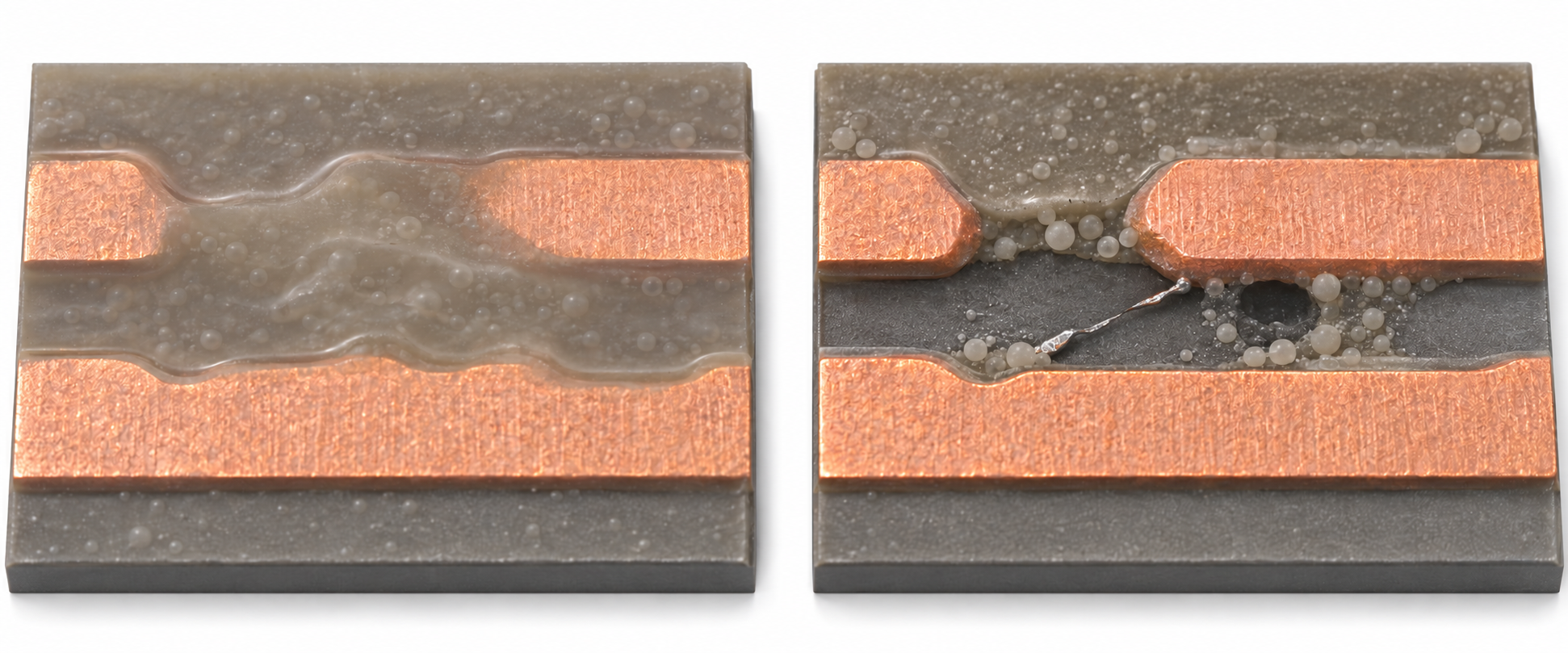
Magnified detail: plasma reveals the metal filament
After access to the target region, remaining Underfill can still obscure a fine metal defect. Staged MIP treatment removes the organic covering so the filament and adjacent void become visible for microscopy and SEM–EDS. The goal is to expose and retain the evidence, not to remove the metallic foreign matter.
| Preparation concern | Potential MIP benefit | Process control |
|---|---|---|
| Metal connections and joints | Reduce acid-corrosion changes to the original geometry. | Validate recipe, temperature and exposure for the actual metallurgy. |
| Organic matrix and filler | Remove the organic phase to improve access. | Resin removal does not automatically remove filler. Record evidence before selecting compatible cleaning. |
| Fragile particles and interfaces | Reduce the need to scrape the target directly. | Avoid unvalidated rinsing, ultrasonics or contact that could move a fragile filament. |
Check whether the material to remove is also the evidence to preserve.
If an organic contaminant is itself the target, retain a reference specimen or perform suitable chemical analysis before choosing plasma treatment. MIP can also alter organic matter or metal surface condition; establish the process window using representative samples and intermediate observations.
03 · EVIDENCE
Keep localization, morphology and composition connected
The existing case images below correspond to localization, opening and composition analysis in the publication. Measurement points, arrows, scale bars and reported values are retained. Image source: UR Hongxin Testing ↗. Original image annotations remain unchanged.
04 · LOCAL OPENING & ELECTRICAL TEST
From full-surface grinding to local opening—with electrical testing in mind
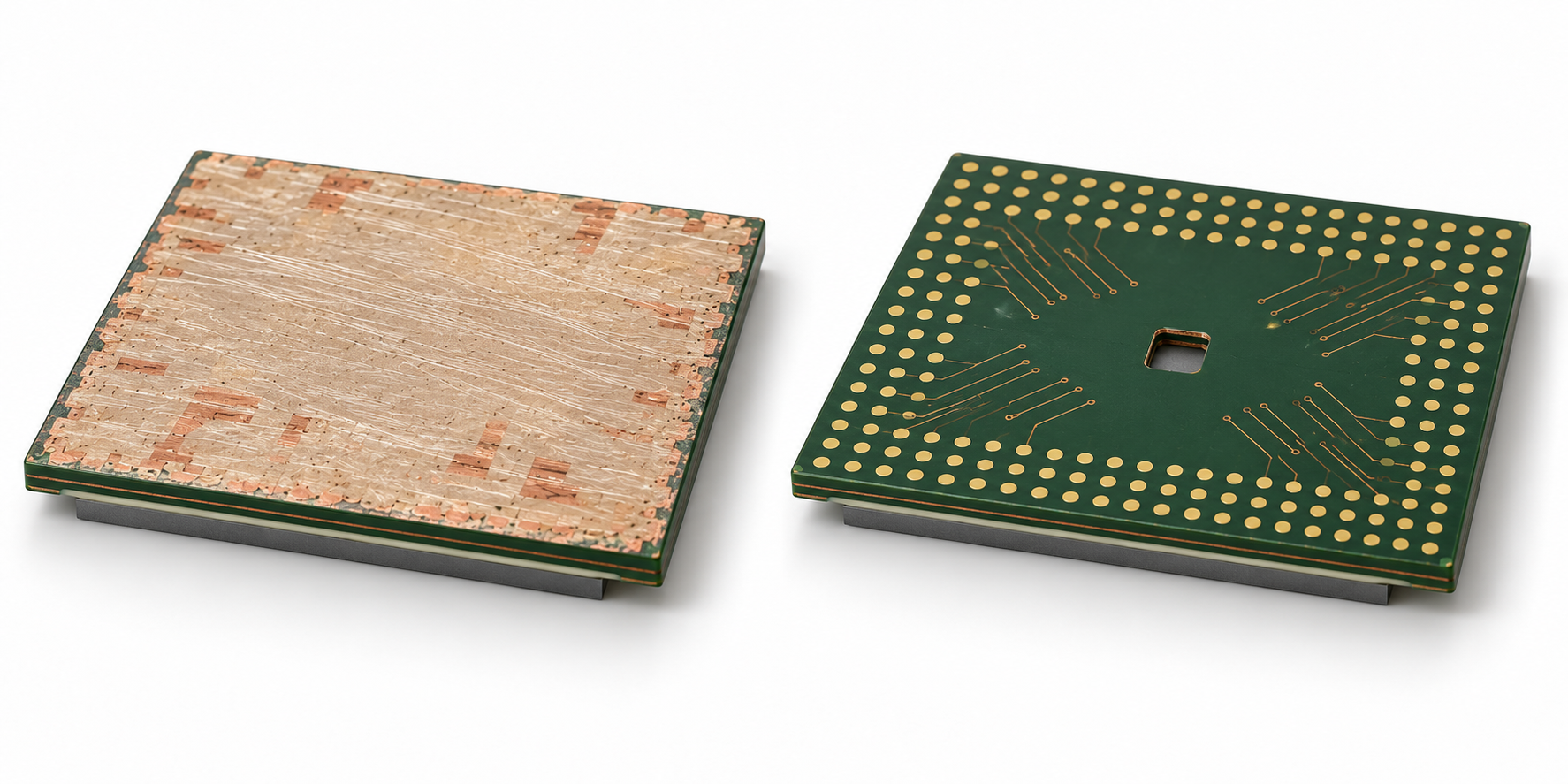
The original preparation used broad manual grinding. This can expose internal structures while also removing routing, pads or interconnects outside the target area, making electrical access difficult to retain. ICDECAP proposes targeted local opening with iMech Pro, followed by MIP removal of organic residue inside the window. Restricting material removal to the region of interest creates a path toward post-decapsulation electrical testing.
Original approach · broad manual grinding
A large area is removed, affecting both target and non-target regions. Routing, accessible contacts or support structures may be lost, leaving morphology as the main follow-on study.
Proposed approach · iMech Pro local opening
Plan window position, area and depth from localization results. Retain as much surrounding substrate, routing and test access as possible, so imaging and electrical retesting can potentially be linked on the same specimen.
| Comparison | Broad manual grinding | iMech Pro local opening + MIP |
|---|---|---|
| Removal footprint | Broad removal also affects regions outside the target. | Define a local window and depth, removing only material needed for target access. |
| Electrical access | Test contacts or relevant routing may be removed. | Map the package and avoid critical networks, retaining usable peripheral connections. |
| Approach to the target | Continued broad grinding may disturb weak metal features or defect morphology. | Create a mechanical access window, then remove organic residue using staged MIP exposure. |
| Next validation step | Primarily exposed morphology and composition. | Where required nets remain connected, compare electrical behavior before and after opening alongside microscopy. |
Proposed route: locate → open locally → MIP → verify electrically
01 · Define the nets to test
Record baseline electrical behavior, target coordinates and accessible terminals. Map critical routing around the planned window.
02 · Open locally with iMech Pro
Approach in stages from a suitable substrate-side entry. Control the window and stopping plane while protecting the die and required connections.
03 · Remove residue with MIP
Expose the metal target and interconnects through staged organic removal. Capture intermediate images and inspect at the endpoint.
04 · Check access, then retest
Verify that contacts and relevant nets remain usable before continuity, leakage or anomalous-net comparisons under suitable excitation.
Move from visual access toward retained test access.
Local opening limits removal outside the region of interest and offers a more targeted route to preserving electrical connections. A particular electrical test remains conditional on avoiding critical nets, retaining interconnects and reaching the required contacts; plan these requirements before preparation.
For a micro-short that may disappear under test current, use validated low-disturbance conditions. The objective is to retain diagnostic capability, not to make the fault disappear. This section proposes an improved preparation route; it does not claim an iMech post-opening electrical test was completed in the published case.
05 · QUESTIONS & ANSWERS
Frequently asked questions
Does plasma opening alone establish the micro-short cause?
It provides access. A root-cause assessment still connects electrical behavior, localization, morphology and composition, while tracking changes introduced during preparation.
Will every contaminant survive MIP treatment?
No. Metals, oxides and organic contaminants respond differently. Identify the material of interest and validate evidence preservation with staged exposure, reference samples and before-and-after records.
How can local opening support post-decapsulation electrical testing?
Restricting grinding to the target region can help retain surrounding substrate, routing and test contacts. Combined with MIP residue removal, this creates an opportunity to retest electrically where the required nets remain connected and terminals remain accessible.
06 · NEXT STEP
Build an analysis route around your target
Flip-chip package
A package in which bumps connect the die to a substrate, with the interconnect region often adjacent to underfill.
MIP plasma decapsulation
An acid-free preparation route using microwave-induced reactive plasma species to remove organic encapsulation material.
iMech Pro local grinding
Precision preparation that defines window position, area and depth, limiting removal outside the target to help retain surrounding structures and electrical connections.
Explore MIP plasma Explore iMech Pro Discuss your sample preparation route →